
Materials / grade-specific review
PVDF Binder (High Molecular Weight)
High-viscosity polyvinylidene fluoride homopolymer for NMP-based cathode slurries, with tight control on metallic impurities and moisture.
APPLICATION & GRADE
Grade / designation: SZ-M1-BD01
Grade and specification to be confirmed
Discuss Material Requirements ↗Typical applications
Cathode slurry for LFP, NCM and LCO electrodes
Separator coating formulation
Laboratory slurry development
Pilot-scale coating trials
Grade & supply review
Molecular weight and solution viscosity
Solids content and pH
Particle size for emulsion grades
Supply form — powder, NMP solution or aqueous dispersion
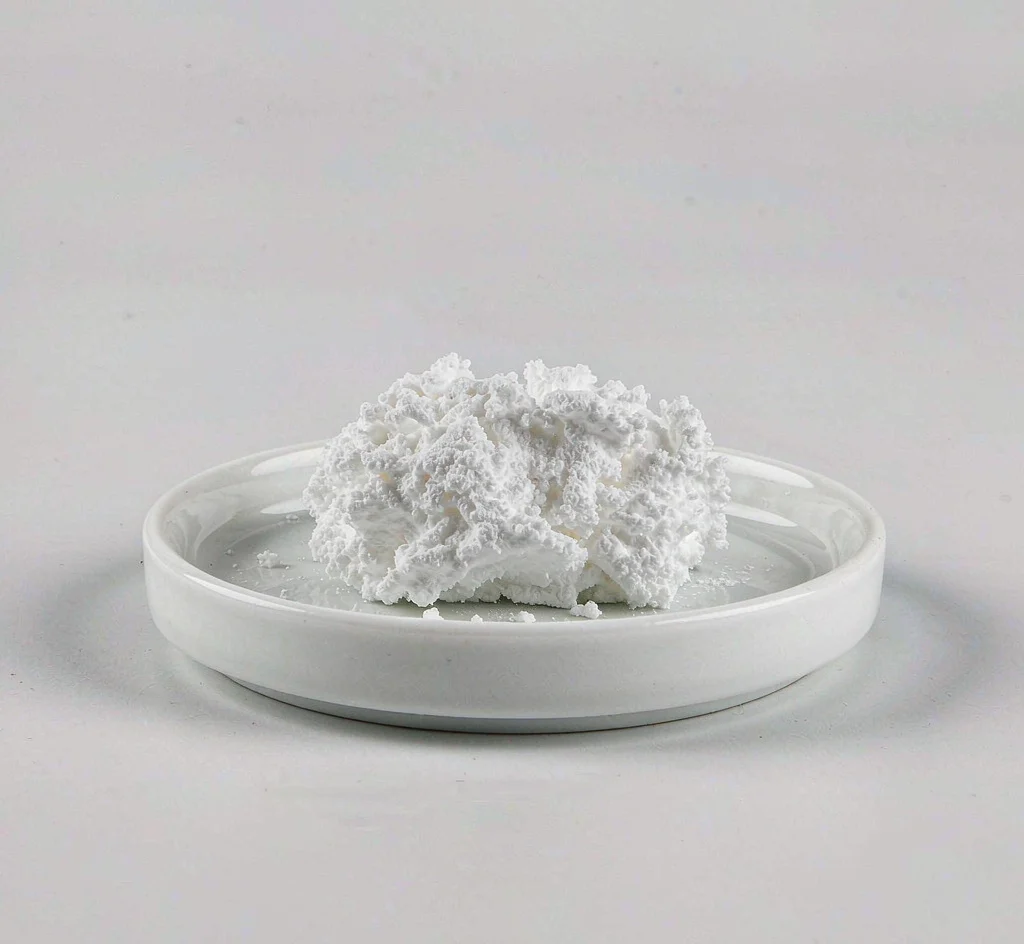
Representative image. Actual material appearance varies by grade and lot — request a current photograph or sample.
About this material
Polyvinylidene fluoride is the standard binder for cathode electrodes because it is electrochemically stable across the full operating window of a lithium-ion cell, adheres well to aluminium foil, and dissolves cleanly in N-methyl-2-pyrrolidone to give a coatable slurry. Molecular weight governs the balance: higher molecular weight improves adhesion and cohesion, but slows dissolution and raises slurry viscosity.
This high-molecular-weight homopolymer is supplied as a fine white powder with a D50 near 10 μm, which dissolves noticeably faster than granular grades at 40–60 °C. Metallic impurities are held below 1 ppm per element because iron, copper and sodium contamination in a binder end up distributed throughout the entire electrode — a failure mode that is hard to trace after the fact.
Documentation, controls and care
Quality controls
- Metallic impurities screened by ICP per lot
- Moisture by Karl Fischer
- Solution viscosity verified at 5% in NMP
- Ash content reported
Handling & storage
- Store below 30 °C in a dry place; reseal immediately after use.
- Dissolve at 40–60 °C with stirring — avoid prolonged overheating.
- Do not process above 350 °C; thermal decomposition releases hydrogen fluoride.
Grades on this page are references used to describe capability; they are not a fixed product list.
Specification values are typical windows compiled from public technical references and supplier
datasheets, and are provided for selection guidance only. The specification delivered against your
order is agreed in writing, and measured values are confirmed on the batch certificate of analysis.
Materials listed here may be hazardous; they must be handled by qualified personnel under applicable
regulations.
Material specifications
| Chemistry | PVDF homopolymer, emulsion polymerised |
|---|---|
| Average molecular weight | 0.9–1.0 × 10⁶ g/mol |
| Appearance | White fine powder |
| Density | 1.77–1.79 g/cm³ |
| Melting point | 162–172 °C |
| Particle size | D50 ≈10 μm |
| Purity | ≥99.95% |
| Metallic impurities | Fe / Cu / Na / K <1 ppm each |
| Moisture | <0.1% |
| Solution viscosity | 47–53 kPa·s at 5% in NMP, 25 °C |
| Recommended loading | 1.5–2.5 wt% of electrode solids |
| Dissolution temperature | 40–60 °C in NMP |
Grade & packaging options
Lower-Mw grade for faster dissolution
PVDF for separator coating
Water-based binder alternatives (SBR / CMC)
Pre-dissolved NMP stock solution
Supply boundaries
Reference grade, not a fixed catalogue item. Capacity, particle size, coating, purity and packaging are set to the specification your process needs — the delivered grade may differ from the values shown here.
Packaging & handling
Laboratory pack | 100 g / 500 g sealed pouch
Pilot pack | 1 kg / 5 kg container
Production pack | 25 kg fibre drum
Information for material review
Cell chemistry, format and voltage window
Target capacity, areal loading or formulation
Process route — NMP/PVDF, aqueous, or dry
Quantity per lot, packing and delivery schedule
Training in China
Training at our China facility is available for this product. Scope, schedule and language are agreed for each project.
Related products

LET’S REVIEW YOUR MATERIAL REQUIREMENTS
Discuss your material specification.
Share the intended use, required grade, quantity and supporting documents you need to review.
support@szotech.com